Saint-Martin-des-Champs Priory
The Last DuelSaint-Martin-des-Champs Priory is the religious landmark associated with the field where the judicial duel between Jean de Carrouges and Jacques Le Gris took place. The site’s significance in the account lies in the way the priory and its surroundings made the combat at once a formal legal ordeal, a royal ceremony, and a spectacle witnessed by thousands.
Identity and Setting
The book’s references distinguish the battlefield, law court, priory, and spectators as connected aspects of Saint-Martin-des-Champs. The duel took place at Saint-Martin’s dueling ground, with the monastery walls enclosing the immediate setting. The account does not establish that the priory owned or administered the field, or describe the community’s internal life; it places the priory in the physical and institutional landscape surrounding the event.
The Field and Its Spectators
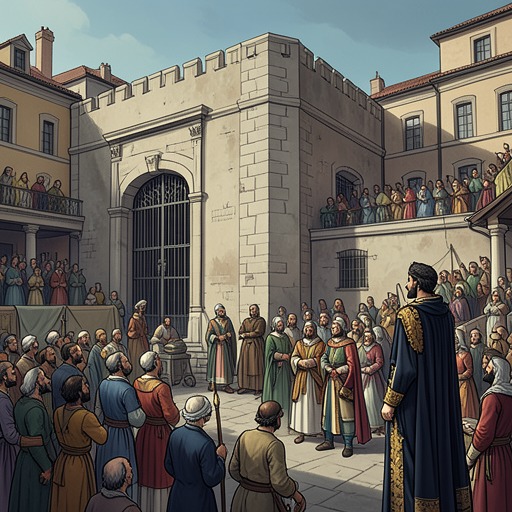
The ground was prepared to receive a large audience. Most spectators were commoners from the city and its suburbs, who watched from the earth around the field; nobles and visitors from distant parts of France and foreign courts were accommodated in timber stands. The central stand was reserved for the king and senior nobility, with separate seating for members of the royal court, foreign nobles, and women. Other stands ranked burghers and merchants above the common people, many of whom watched through gaps in the high wooden fencing.
The field’s structure controlled both access and attention. An inner enclosure had guarded entrances, and wooden towers at its four corners gave officials a close view of the combat and a means of supplying the fighters with food and drink. A lower outer wall had its own barred entrances; guards kept the crowd back and prevented noise or disturbances from interrupting the proceedings. The arrangement turned the priory’s surroundings into a carefully regulated viewing space, divided by walls, gates, and social rank.
Ceremony and Public Order
The king presided over the duel in the capacity authorized by the Parlement of Paris. The combat could not begin until he arrived and took his place in the royal stand; the ceremonies then proceeded under royal authority. The herald’s rules prohibited spectators from carrying weapons or remaining on horseback, and required them to stay seated without obstructing others. Speaking, gesturing, or making noise during the battle was forbidden on pain of severe punishment. The crowd’s silence was thus part of the procedure, not merely a sign of attention.
That enforced quiet ended when Carrouges, after the combat, turned toward the royal stand and asked whether he had done his duty. The gathered spectators answered together, and their affirmation carried beyond the priory walls into the surrounding district and streets of Paris. The site that had contained a hushed, regulated hearing of the duel became the point from which news of its outcome spread through the city.
Significance
Saint-Martin-des-Champs Priory matters in the narrative chiefly through this conjunction of place and event. Its walls and neighboring ground situated the duel within a religious landscape, while the stands, barriers, guards, and royal presence made the field a public arena governed by legal and social hierarchy. The event’s resolution was not visible to spectators as a direct judgment about the disputed accusation; it was made publicly legible through the combat’s result and the crowd’s response. The priory’s setting therefore anchors a spectacle in which authority, procedure, and collective witness converged.